Showing posts with label Language | Arts. Show all posts

03 February 2010

A Friendly Reminder: Do Not Blanch Your Sun-Dried Underwear


Sorry for the fuzzy pic; I am laaaaazzzy and didn't feel like plugging in the scanner.


Special cares

  • Do not leave soaking

  • Wash separately

  • Do not use blanch or soap with blanch

  • Do not twist

  • Avoid contact with rough superficies

  • Dried out of the sun

  • Do not iron

06 December 2009

This is what happens when you fire all the real journalists

From one of today's business articles on AnnArbor.com:

Like the ancient centaur of Greek mythology, these locally owned franchises are half-local, half-chain and have carved a unique niche in the local Ann Arbor business landscape.


LOLWhut?

04 July 2008

Thoughts on Democracy

tod_2x4

Thoughts on Democracy reinterprets Norman Rockwell's famous Four Freedoms posters.

Enjoy your weekend.

16 February 2008

Google Search: See Image Alone

Ver la imagen sola
Image uniquement
Bekijk slechts de afbeelding
Zobacz sam obraz
Se endast bilden
Teljes méretű kép megtekintése
Vaata pilti üksikult
Rodyti vien tik vaizdą
Lihat gambar ini saja
Bild alleine anzeigen
Prikaz samo slike
Görseli tek başına görüntüle

09 January 2008

Rumi for Your Mid-Week: Let's Go Home

Late and starting to rain, it's time to go home.
We've wandered long enough in empty buildings.
I know it's tempting to stay and meet those new people.
I know it's even more sensible
to spend the night here with them,
but I want to go home.

We've seen enough beautiful places with signs on them
saying This is God's house.
That's seeing the grain like the ants do,
without the work of harvesting.
Let's leave grazing to cows and go
where we know what everyone really intends,
where we can walk around without clothes on.

-- Translated by Coleman Barks

11 December 2007

Happy Birthday

I spent my entire day working on the final project for a class: a magazine redesign. Okay, I wasn't working on it for the two hours I was at Paesano's being fed pheasant and bigoli pasta and a big juicy glass of wine. For the redesign, I've been working on WildBird because a) it needs it and b) I like birds. (I especially like them in a ragu with bigoli.)

The project really came together this evening, and I keep looking at how...now, this might sound silly...but how real it looks. Like, this could actually be on a shelf in a bookstore:


Like, holy shit, I finally feel like I'm good at something.
Like I'm finally real.
It only took 34 years.

09 December 2007

Hand-Crafted Journals

journals

Thanks to a free tutorial that came to me via Photojojo, I've learned how to make little notebooks. The 4" by 6" photo prints are held to the inside sheets like a perfect-bound book with white glue and I use cut magazine covers for the spines.

08 November 2007

НАРЦИССЫ ТРУБЧАТЫЕ

bulbpackage

I bought a package of anemone bulbs on sale today, and was intrigued to find that the flower name was translated as "tubular narcissus" in Russian. Narcissus in Russian is the same as narcissus in English - a daffodil (only in Cyrillic), so I'm a little baffled.

08 July 2007

26 April 2007

Type and Shape

Typography Assignment - Type and Shape

One class finished.
One to go.

04 December 2006

But They Didn't Ask About "Pop" or "Chipped Ham"

What American accent do you have?
Your Result: The West

Your accent is the lowest common denominator of American speech. Unless you're a SoCal surfer, no one thinks you have an accent. And really, you may not even be from the West at all, you could easily be from Florida or one of those big Southern cities like Dallas or Atlanta.

The Midland
Boston
North Central
The Inland North
The Northeast
Philadelphia
The South
What American accent do you have?
Take More Quizzes

20 June 2006

Sonnet 34

Why didst thou promise such a beauteous day,
And make me travel forth without my cloak,
To let base clouds o'ertake me in my way,
Hiding thy bravery in their rotten smoke?
'Tis not enough that through the cloud thou break,
To dry the rain on my storm-beaten face,
For no man well of such a salve can speak
That heals the wound and cures not the disgrace:
Nor can thy shame give physic to my grief;
Though thou repent, yet I have still the loss:
The offender's sorrow lends but weak relief
To him that bears the strong offence's cross.
Ah! but those tears are pearl which thy love sheds,
And they are rich and ransom all ill deeds.

-- William Shakespeare

05 June 2006

I Know What I Like When I See It

The usual format of the writers' group I am in is thus: author reads, critics mull and re-read and mark up, critics discuss, and finally author is allowed to speak and answer questions.

Tonight, over plates of chicken salad wraps at the aut Bar, I read the poem posted below at 18 May. I could barely hear myself over the stereo system blaring Dido into the courtyard. When I finished, the critics sat and figeted with their pens. When the discussion rolled around, they unanimously liked it. Loved it even. Every-single-line-is-beautiful, this-is-so-sensual-and-intriguing loved it.

But they didn't know what it meant.

H. put forth several interpretations. As the group talked it over, I started to wonder if even I knew what it meant.

"It must be a good poem," S. said. "I don't understand it."
"I've decided to just leave it a mystery," said L.
"You should submit this somewhere," H. said. "Like The New Yorker."

I laughed.

M., the real poet of the group, merely winked at me and pointed out some too-ordinary words.

18 May 2006

Pygmalia

His lips first I fashioned,
apple blossoms I bit the pink curve into;
His cheeks next,
musky clay warmed round by my palm cups,
stubbled with bur oak acorn caps.
Two river-rubbed rocks I set for his eyes,
glinting with schist like silver minnows.
His neck sinews last winter’s grapevine
I braided around the antlers of his collarbones.
For his back an acre’s ground,
each vertebrae a fossil unturned.
Two mounds of earth I kneaded into buttocks,
bound to a hickory my arms’ circumference measured,
forking down to grounded knotty roots,
forking up to a driftwood-smooth branch
from which I hung a spider’s sack
cradling a pair of dusky plums.
An armful of moss I distributed,
a little bit everywhere;
a thatch of wild vetch his crown;
fronds to point the delicate curling way
home down his belly.
Last I pressed my tongue to form
the moist interior nautilus of his mouth,
whispered into the snail shells of his ears
his secret name,
and brought my self to life.

13 May 2006

The Da Vinci Overload

Enough! Enough already! It’s a made-up story, people! Fiction! A novel! Not even a particularly well-written one!

IT IS NOT THE BIBLE!

ps. The Bible is mostly stories too.

27 March 2006

Scrimp the Obscure (and Well-Formatted)

Scrimp (skrimp) a. and adv. [This and the related SCRIMP v. first appear in the 18th c. The origin is obscure; cognate forms are Sw., Da. skrumpen shrivelled, MIIG, schrimpfen (Mid. Ger. schrimpen str. vb.) to contract, trans. to wrinkle up (the nose), G. schrumpfen to shrivel; also SHRIMP sb., in ME., a diminutive creature. More remotely allied are OE scrimman to be paralysed, SCRAM a]
A. adj. Scant, scanty, meagre.
B. adv. Scarcely, barely. Obs.

Scrimp (skrimp), v. Also Sc. skrimp. [See SCRIMP a.]
1. trans. To keep on short allowance; esp. with regard to food.
2. To cut short in amount; to be sparing of.
3. intr. To economize, to be niggardly.
Hence, SCRI•MPING vbl., sb. and ppl.a.

Scrimped (skrimpt), ppl. a. Also 8 Sc. scrimpit, -et. [f. SCRIMP v. +ED¹.] Stinted, contracted, narrow.

Scrimpiness (skri•mpines). [f. SCRIMPY a. + -NESS] “Scrimpy” quality, meagreness.

Scrimple, v. Obs. rare. [Cf. CRIMPLE v; also SCRUMPLE v. and G. schrumpfeln, schrumpfen] trans. To shrivel with fierce heat, to scorch. Also to crumple, crinkle. Hence Scri•mpled ppl. a.

Scrimply (skri•mpli), adv. [f. SCRIMP a. +-LY²]
1. In a niggardly, parsimonious manner.
2. Barely, scarcely.

Scrimpy (skri•mpi), a. [f. SCRIMP a. + Y.] Of meagre dimensions, scanty.

19 February 2006

Heh-heh. She Said, "Laid."

Good afternoon, my fine Hawklets. Find the error in today's headlines on Excite:

News2.19


Kudos to those who know the jackpot winner is really "lying low" and not "laying low."

Here's the low down. "Lay" means "to place or put." It's a transitive verb and needs an object. "Lay" is something you do to something else. You lay a book on a table. "Lie" means to "to recline." It is an intransitive verb and does not act upon anything else. You just lie down, no object required. You lie low. Or, to use the present participle, you are lying low.

Confusion seeps in with phrases like "Now I lay me down to sleep." Hey - shouldn't that be "lie?" No, because In this case, "me" is the object being acted upon. Further confusion arises in past tense, because the past tense of "lay" is "laid," and the past tense of "lie" is, just to muck things up, "lay."

Past participle is where it gets really hairy, and I admit even the Kimmijo gets this one wrong. The past participle of "lay" is "laid," as in "They have laid 500 feet of pipe a day." The past participle of "lie" is the endangered, rarely spotted "lain," as in, "I could have lain in bed all day."

Don't feel badly about this one. This particular grammar obfuscation has been going on since the 1300's. I take it as evidence against intelligent design. It also made my seventh grade English teacher cry, because we all giggled and whispered every time she said, "laid."

ps. "Layed" does not exist, except as a misspelling.
pps. Next on "Law & Order: Grammar Police": Affect/effect!

29 June 2005

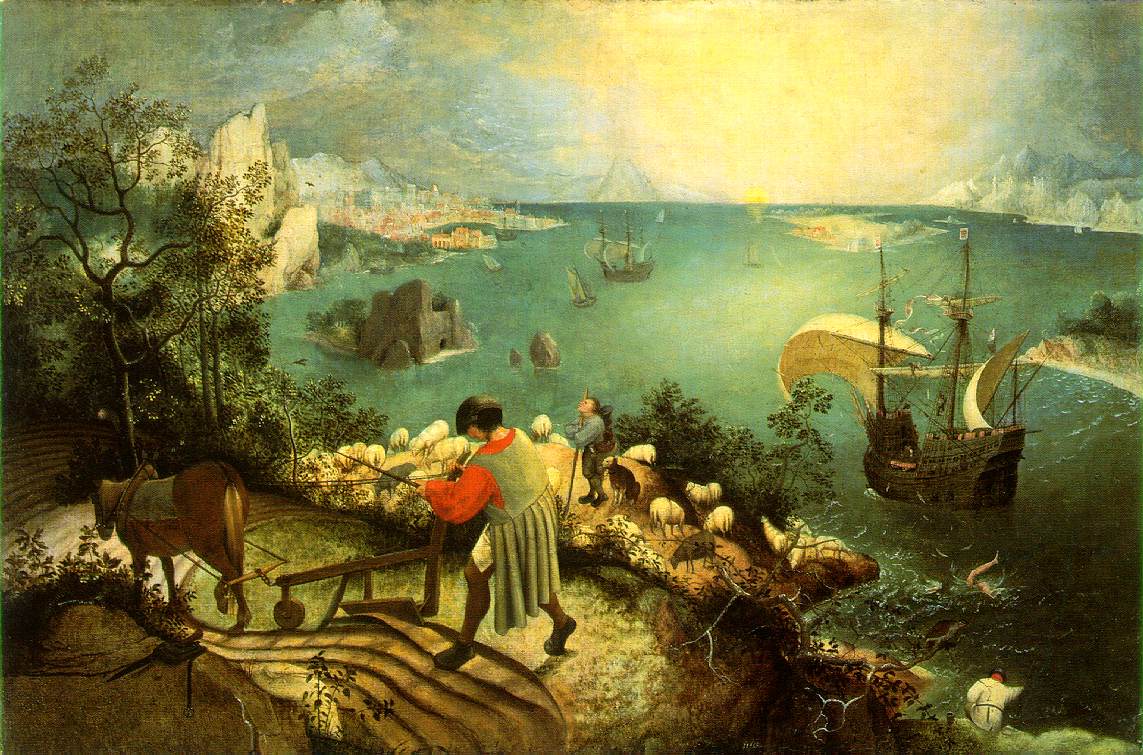
Musee des Beaux Arts

About suffering they were never wrong,
The Old Masters; how well they understood
Its human position; how it takes place
While someone else is eating or opening a window or just walking dully along;
How, when the aged are reverently, passionately waiting
For the miraculous birth, there always must be
Children who did not specially want it to happen, skating
On a pond at the edge of the wood:
They never forgot
That even the dreadful martyrdom must run its course
Anyhow in a corner, some untidy spot
Where the dogs go on with their doggy life and the torturer’s horse
Scratches its innocent behind on a tree.

In Breughel’s Icarus, for instance: how everything turns away
Quite leisurely from the disaster; the ploughman may
Have heard the splash, the forsaken cry,
But for him it was not an important failure; the sun shone
As it had to on the white legs disappearing into the green
Water; and the expensive delicate ship that must have seen
Something amazing, a boy falling out of the sky,
had somewhere to get to and sailed calmly on.

-- W.H. Auden